Balancing Trade Workloads So the Takt Train Does Not Break

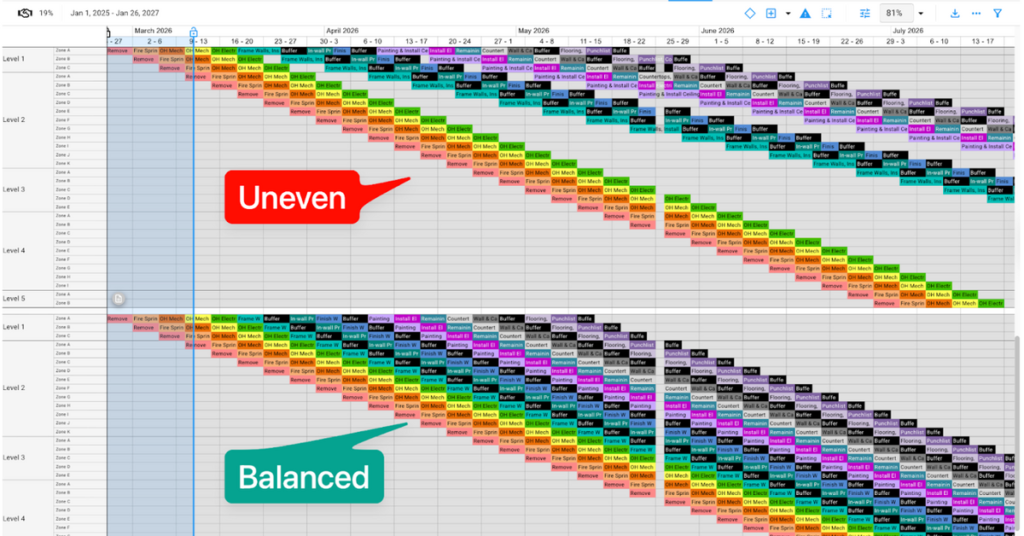
Balancing is not about making every trade happy. It is about creating a stable rhythm that the project can maintain. Stability is what prevents firefighting. If the same trade is always behind, the system is telling you something. Either the work is uneven, the zone is not truly repeatable, or the plan is not matched to actual crew capacity.

Start with quantities by zone. You do not need perfection, but you do need honesty. Break the scope into repeatable chunks, then compare time required per trade per zone. When you discover one zone has twice the effort, that zone is not a repeat, it is a risk. Name it, then decide whether to split it, resize it, or treat it differently with a planned buffer.

Next, look at crew shape. Some trades do not scale linearly with manpower, and some scopes have setup time that dominates. Balancing sometimes means changing the sequence, not just adding people. It can mean a two pass approach, rough then finish, so the train keeps moving while detailed work follows in a controlled way.

Also consider trade interference. A plan can be balanced on paper and still fail in the field if two trades need the same space at the same time. Balancing is not only time, it is space. This is why zoning and sequencing must be developed together, not in isolation.

A practical balancing workshop includes foremen. Ask them, in plain terms, where they anticipate losing time. Capture their concerns as production facts, not opinions. When foremen see that the plan reflects reality, they are far more likely to follow it, defend it, and improve it.

As the project runs, use simple metrics to keep balance honest. Did the trade finish the zone inside the beat. Was the handoff clean. What was the reason for variance. Using inTakt to track these patterns makes it easier to spot chronic imbalance early, before it becomes a schedule crisis.

Balancing is not a one time activity. It is a continuous system improvement loop. Each week you learn where the plan and reality disagree, and you adjust the system so flow gets stronger over time.
Share

Recent Posts

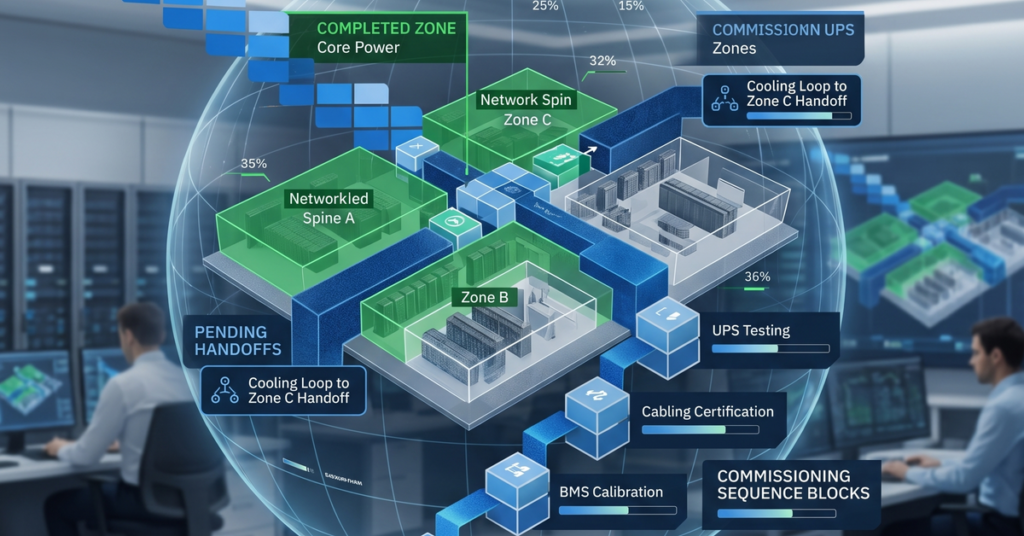
Data center commissioning zone map showing completed zones, pending handoffs, and commissioning sequence blocks

inTakt

June 5, 2026

How Takt Planning Supports Faster Data Center Commissioning

Commissioning is one of the most critical phases of data center construction. It is also one of the most schedule-sensitive. By the time a project reaches commissioning, every upstream delay matters. Incomplete rooms, missing equipment, unfinished systems, failed inspections, or unresolved punch items can all slow down testing and turnover. The problem usually begins earlier. If construction work does not flow properly through the building, commissioning teams inherit the consequences….

inTakt

June 4, 2026

Why Data Center Construction Needs Real-Time Schedule Visibility

Data center projects change quickly. A delivery shifts. A room is not ready. A trade finishes early. A commissioning activity reveals an issue. A constraint appears in a critical area. When that happens, teams need visibility immediately. Traditional schedules often lag behind field reality. By the time updates are collected, reviewed, entered, and redistributed, the jobsite may have already moved on. That delay creates confusion. Some teams work from the old plan. Others work from verbal…

inTakt

June 3, 2026

How Lean Construction Planning Improves Data Center Delivery

Data centers demand predictable delivery. But predictability is difficult when teams rely only on traditional scheduling methods. These projects include complex systems, aggressive deadlines, high-quality expectations, and many specialized trade partners. Every delay creates a chain reaction. Lean construction planning helps teams reduce that uncertainty. Instead of focusing only on task completion, lean planning focuses on workflow reliability. The goal is to reduce waste, improve handoffs,…

More Than Logic. Built for Production.

Traditional CPM tools manage activities and relationships. If you run full Takt, you’ll love it! If you run traditional CPM, you’ll wonder why your software never did this before.