Why Your Construction Schedule Looks Good But Fails In The Field

But the moment you step onto the jobsite, a different reality shows up.

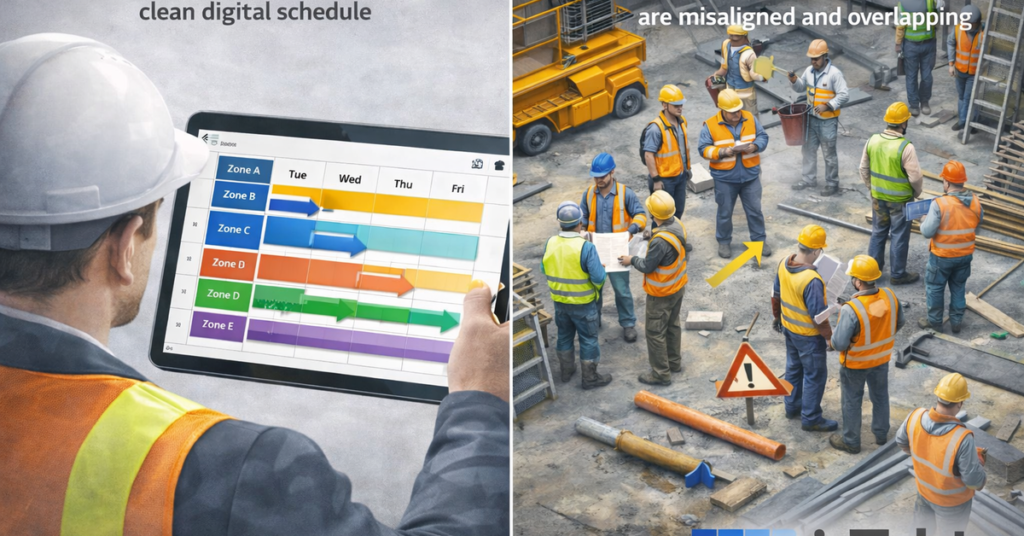
Crews are waiting for access. Work is happening out of sequence. Teams are asking basic questions about what should be happening next. And despite having a “complete” schedule, the project feels misaligned.

This gap between planning and execution is where most projects struggle—not because the plan is wrong, but because it isn’t usable in the field.

Traditional construction scheduling software was built to organize tasks, not to manage how work actually flows through space. It focuses on timelines and dependencies, but it rarely reflects real-world conditions like trade interaction, physical constraints, or readiness of work areas.

As a result, teams are forced to interpret the schedule instead of follow it.

When the schedule isn’t clear, crews start making decisions on their own. One team moves ahead to stay busy, another delays because conditions aren’t ready, and a third enters a space assuming it’s available. Individually, these decisions seem reasonable—but together, they create misalignment that slows the entire project down.

What high-performing teams do differently is not just “plan better.” They make the schedule visible, practical, and aligned with how work actually happens.

They connect activities to real areas. They sequence work in a way that reduces overlap. And most importantly, they ensure the entire team is looking at the same, current plan.

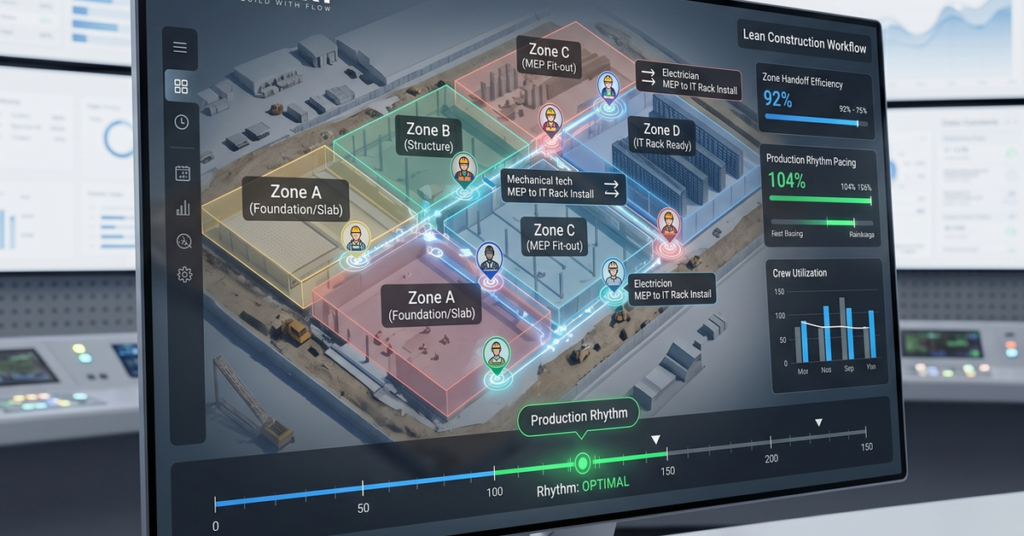
With inTakt, the schedule becomes a live production system instead of a static document. Zones are clearly defined, updates happen in real time, and everyone—from supers to trades—can see exactly what’s happening and what’s coming next.

Instead of asking, “What changed?” teams start operating with clarity and confidence. Work flows from one area to the next, handoffs improve, and coordination becomes natural instead of forced.

Because at the end of the day, a schedule doesn’t create value by looking organized.
Share

Recent Posts

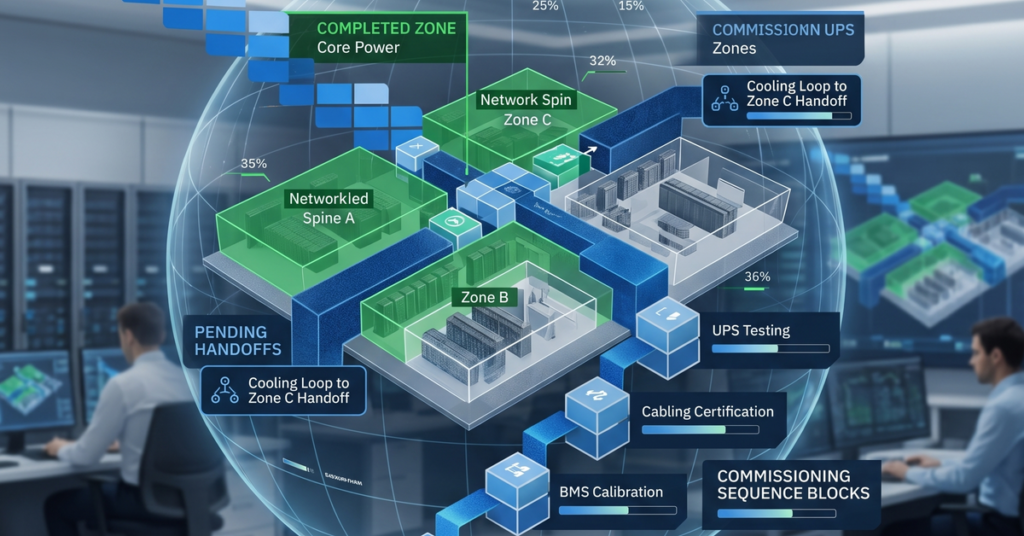
Data center commissioning zone map showing completed zones, pending handoffs, and commissioning sequence blocks

inTakt

June 5, 2026

How Takt Planning Supports Faster Data Center Commissioning

Commissioning is one of the most critical phases of data center construction. It is also one of the most schedule-sensitive. By the time a project reaches commissioning, every upstream delay matters. Incomplete rooms, missing equipment, unfinished systems, failed inspections, or unresolved punch items can all slow down testing and turnover. The problem usually begins earlier. If construction work does not flow properly through the building, commissioning teams inherit the consequences….

inTakt

June 4, 2026

Why Data Center Construction Needs Real-Time Schedule Visibility

Data center projects change quickly. A delivery shifts. A room is not ready. A trade finishes early. A commissioning activity reveals an issue. A constraint appears in a critical area. When that happens, teams need visibility immediately. Traditional schedules often lag behind field reality. By the time updates are collected, reviewed, entered, and redistributed, the jobsite may have already moved on. That delay creates confusion. Some teams work from the old plan. Others work from verbal…

inTakt

June 3, 2026

How Lean Construction Planning Improves Data Center Delivery

Data centers demand predictable delivery. But predictability is difficult when teams rely only on traditional scheduling methods. These projects include complex systems, aggressive deadlines, high-quality expectations, and many specialized trade partners. Every delay creates a chain reaction. Lean construction planning helps teams reduce that uncertainty. Instead of focusing only on task completion, lean planning focuses on workflow reliability. The goal is to reduce waste, improve handoffs,…

More Than Logic. Built for Production.

Traditional CPM tools manage activities and relationships. If you run full Takt, you’ll love it! If you run traditional CPM, you’ll wonder why your software never did this before.